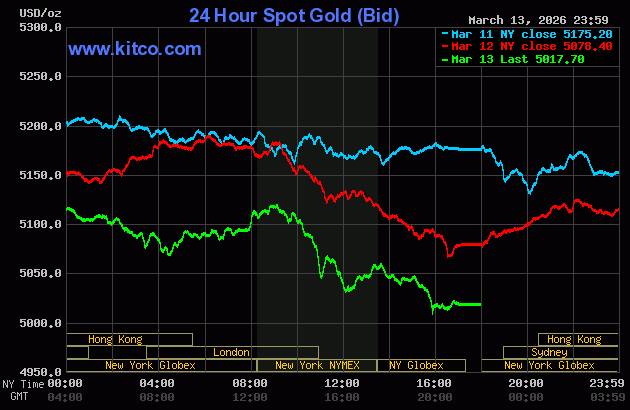
The allure of gold has captivated investors for millennia, but in today's dynamic economic landscape, the precious metal is more than just a historical store of value; it's a barometer of global uncertainty. The market for gold is currently experiencing a significant tug-of-war, with prices showcasing considerable volatility as investors navigate a complex web of economic signals, geopolitical tensions, and the persistent question of the Federal Reserve's next move on interest rates. For anyone tracking the value of their assets, understanding the current Gold Price Today Usd and its underlying influences is crucial.
Recent Swings in the Gold Market: A Closer Look at US Prices
The past few weeks have underscored the erratic nature of the gold market. We've witnessed a notable rally, with spot gold prices breaching the psychologically significant $5,000 per ounce mark. Specifically, recent data showed spot gold climbing to $5,047.10 per ounce, reflecting a 1% increase, while U.S. gold futures for April delivery similarly rose by 1.4% to $5,065.70 per ounce. This upward momentum was partly fueled by weaker-than-expected U.S. growth data, which indicated a slowdown in the fourth quarter's annual GDP rate to 1.4%.
However, this rally wasn't without its precursors. Earlier in the week, prices had seen a sharp decline, plummeting over 2% to $4,841.74 per ounce before finding a rebound. This "rollercoaster" movement highlights the inherent uncertainty gripping the market, where a single economic report or geopolitical headline can trigger rapid shifts. For investors looking at the Gold Price Today Usd, these fluctuations are a reminder that while gold often acts as a safe haven, its path to stability can be anything but smooth in the short term.
Decoding the Drivers: Why is Gold Volatile?
Several intertwined factors are currently orchestrating gold’s price trajectory, creating the volatility seen in the market:
- Economic Growth Concerns: Sluggish U.S. economic data, such as the aforementioned GDP slowdown, often fuels expectations of Federal Reserve interest rate cuts. When interest rates are expected to fall, the opportunity cost of holding non-yielding assets like gold decreases, making it more attractive relative to interest-bearing alternatives like bonds or savings accounts. This dynamic directly impacts the Gold Price Today Usd.
- Federal Reserve Policy & Interest Rates: The Fed's stance on monetary policy is arguably the most dominant factor. Hints of a pivot towards rate cuts tend to weaken the U.S. Dollar. A weaker USD makes gold cheaper for international buyers holding other currencies, thereby increasing demand and pushing prices up. Conversely, hawkish signals (indicating higher rates) strengthen the dollar and exert downward pressure on gold.
- U.S. Dollar Strength/Weakness: Gold and the U.S. Dollar generally share an inverse relationship. When the dollar weakens, gold prices tend to rise, and vice-versa. This is because gold is denominated in USD globally, so a weaker dollar enhances its appeal to international investors.
- Geopolitical Tensions: Global instability, conflicts, or significant political events typically boost gold's appeal as a safe-haven asset. In times of crisis, investors flock to gold, perceiving it as a reliable store of wealth that is less susceptible to the volatility of equity markets or currency fluctuations.
- Inflation Expectations: While not explicitly mentioned in the recent drivers, inflation is a perennial factor for gold. Gold is often seen as a hedge against inflation. If investors anticipate rising inflation, they might turn to gold to protect their purchasing power, driving prices higher.
The current market environment, characterized by lukewarm economic growth, fluctuating inflation expectations, and ongoing geopolitical friction, creates a perfect storm for heightened gold volatility.
Navigating Current Gold Rates in the USA
Beyond the overarching market indicators, many individuals are interested in the retail Gold Price Today Usd for specific purities and units in the USA. As of March 15th, 2026, the live gold price in the USA for 22K gold stands at approximately $161.40 per gram, while 24K gold is priced at around $174.96 per gram.
Understanding these rates for different denominations is crucial whether you're buying jewelry, coins, or larger investment bars:
- Per Gram:
- 22 Carat Gold: $161 USD
- 24 Carat Gold: $175 USD
- Per Ounce (approximately 31.103 grams):
- 22 Carat Gold: $5,020 USD
- 24 Carat Gold: $5,442 USD
- Per Kilogram (1000 grams):
- 22 Carat Gold: $161,401 USD
- 24 Carat Gold: $174,958 USD
- Other Common Units:
- 1 Sovereign (7.32 grams, 22K): $1,182 USD
- 1 Tola (11.66 grams, 22K): $1,883 USD
These prices are updated in real-time from top international markets, ensuring they reflect the latest global supply and demand dynamics. The difference between 22K and 24K gold is purity; 24K is 99.9% pure gold, while 22K contains 91.67% gold mixed with other metals for durability, often used in jewelry. For a deeper dive into the specific reasons behind recent surges, including how a weaker USD and Fed bets are fueling gold's climb, you can explore our detailed analysis.
Monthly Trends & Future Outlook for Gold Price Today USD
Analyzing monthly trends provides valuable context for the current Gold Price Today Usd. Looking at March 2026, the average price for 22K gold has been around $164.3 per gram, a notable increase compared to the February 2026 average of $159.83 per gram. This upward trend within March saw highs reaching $169.7 for 22K and $183.95 for 24K on the 1st of the month, contrasting with lows of $161.3 for 22K and $174.84 for 24K on the 14th.
Comparatively, February also experienced significant movement, with 22K gold peaking at $168.65 and hitting a low of $148.55 per gram. These month-to-month fluctuations highlight the responsive nature of the gold market to evolving economic narratives and investor sentiment. The overall trend indicates a cautious but persistent bullish sentiment that has driven prices higher over recent months, despite the short-term dips.
What does this mean for the future outlook? The trajectory of the Gold Price Today Usd will heavily depend on several ongoing developments:
- Federal Reserve's Next Move: Any definitive signals or actions regarding interest rate cuts will undoubtedly be the primary catalyst for significant price movements.
- Economic Data: Further indicators of U.S. economic growth, inflation, and employment will shape the Fed's decisions and, consequently, gold's appeal.
- Geopolitical Stability: Easing or escalating global tensions will continue to influence gold's role as a safe-haven asset.
- Dollar Performance: The relative strength or weakness of the U.S. Dollar against other major currencies will play a crucial role in gold's attractiveness to international buyers.
While gold has historically shown remarkable stability over the long term, its short-term movements are a testament to the complex interplay of these global forces. Investors should monitor these variables closely to anticipate potential shifts. To keep abreast of these real-time fluctuations and observe how live gold prices in the USA, including 22K and 24K rates, trend monthly, our dedicated tracking tool provides invaluable data.
Conclusion
The gold market currently presents a landscape of both opportunity and caution. While the recent surge past the $5,000 per ounce mark highlights gold's potential as a safe haven and a beneficiary of economic uncertainties, the underlying volatility demands a nuanced understanding. Factors like Federal Reserve policy, U.S. economic data, and the strength of the dollar remain pivotal in shaping the Gold Price Today Usd. For investors in the USA, staying informed about current 22K and 24K rates, analyzing monthly trends, and understanding the broader economic context are essential steps in making informed decisions about this timeless asset.